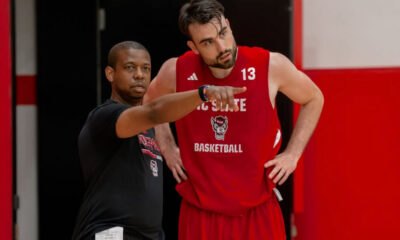
Last night, during the game, social media lit up when 6’9 junior, Ismael Diouf, who rarely plays, knocked down a 3-pointer after scoring on a ‘face up and drive’ layup. He went on to score again near the end of the first half, giving him 7 points in the first 20 minutes.
Everyone finally got to see Ismael Diouf’s full skill set and they wanted more. Unfortunately, NC State rarely got him the ball, he only attempted one more shot in the second half, and finished the game with those 7 points, on 3-4 shooting, 3 rebounds, and one block in 24 minutes.
Look, Ismael Diouf isn’t a savior, but he is the only guy on this roster who has the size and skillset of a natural 4 man.
He’s able to spread the floor with his shot, he’s aggressive when he faces up and attacks, and he’s a pretty good back-to-the-basket post player. Sure, he’s a little soft, it is his first season in the ACC and he’s barely been able to get acclimated to the physicality with the minuscule amount of minutes he’s been given.
I’m just not sure what people are watching.
Small-ball was a theory that had its moment about 10 years ago. It caught teams off-guard since their rosters weren’t built to deal with it. Those teams adjusted to it, scouted for it, and now what was once a mismatch for you the small-ball team, is now a nightly mismatch for the bigger team.
In very rare occasions is the small ball game works these days, and when it does there is a stipulation. Maybe you’re ok with having a 6’7 4-man when your 2 and 3 are big mismatches at 6’6 and 6’5. Or maybe your game is to go small and fill your team up with shooters. That’s worked before, however not as often.
At the end of the day, trying to constantly create a small-ball team that’s able to compete is hard. Because it’s hard to find elite shooters who can defend, and it’s hard to find physically imposing 6’5 guys who can play the 2. But the high schools are flush with 6’3 guards who can score, and 6’7-6’9 wings who can stretch the floor and give you some versatility at the wing.
These trends/systems are almost always ‘flashes in the pan’. Basketball almost always settles back into the traditional make-up of a starting 5…
PG: A chaos-creating distributor (who is a capable shooter/scorer),
SG: A 3-level scorer who can create off the dribble and handle the ball if needed.
SF: A versatile tweener (this is where the most variation can come. This can be a shooter, an elite defender, a tall physical slasher, etc),
PF: A 6’9 swing man who can stretch the floor at the 4 with his jumper. Score with his back to the basket, and give you little rebounding/rim protection
C: A big, physical rim protector and rebounder (bonus if he can score and pass)
- NC State doesn’t have a chaos-creating distributor. The best they have there is Marcus Hill, who could fit this mold if he were challenged to, and if he would be given the opportunity.
- NC State does have a 3-level scorers who can create off the dribble and handle the ball if needed. That’s Trey Parker, but he’s been put on the ball at PG where his itchy trigger finger is doing a little more harm than good. You could fit Taylor in here as well, but to a lesser degree on offensive, and to a greater degree on defense.
- NC State does have a few versatile tweeners in Dontrez Styles (6’6), Paul McNeil Jr (6’6), Dennis Parker Jr (6’6), and Jayden Taylor (6’4). The problem is, only Jayden Taylor is every in this spot. McNeil can’t seem to get any minutes for Keatts and Styles and Parker Jr are relegated to the 4 because Keatts refuses to tinker with his ‘system’ (which has been so bad that it now deserves quotations around it).
- NC State does have a 6’9 swing man who can do all of the things listed above, in Ismael Diouf. But the #1 draft selection in the Canadian league can’t seem to get off the bench for Kevin Keatts, and when he does, he’s got him penciled in a finesse undersized 5.
- NC State does have a big, physical, rim protector and rebounder in Ben Middlebrooks. Sure, he’s not the best rebounder or back-to-the-basket scorer, but the guy is tough, physical and willing to do the dirty work. He’s good enough to fill this role.
Now, just because State could fill these positions, doesn’t mean they’ll suddenly become some Top-25 contender. That ship kind of sailed in the off-season when the roster was created. To get there I think you’d need upgrades at just about every position and full system change, but if they used what they have, in the way those players are intended to be used, they wouldn’t be sitting in second to last place in the ACC after coming off a ACC Tournament and Final Four run.
Look, this isn’t me making something up. It’s me watching basketball. Watching winning basketball, and having the ability to recognize patterns. And you know what almost EVERY successful team has in common? Their front court is big (two guys at 6’8 or greater).
Do you know why that happens to be true? Because the easiest way to get baskets in this game is to get close to the hoop. And the taller you are, the closer you are to the hoop. The closer you are to the ball rebounding off the hoop. The taller you are, the more a shooter has to adjust his shot over you. The taller you are the further off a guy you can play and still contest his shot.
I know I sound like a dad talking about basketball to his 5th-grade son, but this isn’t rocket science.
Because I know you guys are going to tell me “It’s not that simple, Joey.” and “Lots of good teams are playing small ball, Joey!” I have gone through the top 15 teams (for the sake of time) to show you how quality teams use their frontcourt.
- Auburn: 6’10, 6’11
- Duke: 7’2, 6’9
- Alabama: 6’11, 6’11,
- Tennessee: 6’11, 6’10
- Houston: 6’8, 6’8
- Florida: 6’11, 6’10
- Purdue: 6’9, 6’10
- Iowa State: 6’11, 6’9
- Michigan State: 7’0, 6’9
- Texas A&M: 6’9, 6’8
- Marquette; 6’11, 6’8
- St. John’s: 6’9, 6’7 (plays big across the board, 6’7, and 6’6 at the 2 and 3)
- Texas Tech: 6’9, 6’6 (shooting 38.1% a Top-10 3 point shooting team in high majors)
- Kentucky: 7’0, 6.7 (plays big across the board, 6’7, and 6’6 at the 2 and 3 )
- Missouri: 6’10, 6’9,
NC State NEVER has someone above 6’6 at their PF position (or whatever they call their 4 spot). It’s always Styles, or Parker Jr. Not once this season has Keatts thought to trot out Ben Middlebrooks 6’10, Ismeael Diouf 6’9, and Dontrez Styles 6’6 together. And NC State is sitting at 9-13 overall and 2-9 in the conference. They have lost 9 of their last 10. They are 2nd to last in the conference and on the outside looking in of the conference tournament.
Meanwhile, coincidently, no Top-15 team other than Texas Tech plays a frontcourt with a guy under 6’7. But Texas Tech happens to be shooting 38% from 3-point range this season. That is Top-10 of all high majors. NC State puts out a similar lineup but shoots just 31% from 3-point range on the season, that’s good for 293rd in the nation.
And for those two schools that are trotting out a 6’6 guys (Kentucky and St. John’s), they are playing a 6’7 guy at the 3 and a 6’6 guy at the 2. So they are still playing the height game, they are just dispersing it across more positions. That said, Kentucky is also a Top-1o 3-point shooting team of all high majors. St. John is the only team playing smaller at the 4, not shooting it well, and still winning at an elite clip. And, as we pointed out, they’re not even playing as small as NC State.
So what is the argument? That small ball works when done right?
I’d argue that it almost NEVER works at this level, and for it to work you need to be one of the better shooting teams in the nation. I mean, outside of his years in Wilmington, has Kevin Keatts ever won playing small ball?
Well he did win in his first season with a very small team. Yurtseven was 7’0, but most of the minutes at the 4 was going to Torin Dorn over Malik Abu. Dorn was 6’5. And it wasn’t like they were big across the board. They had Al Freeman 6’5, Markell Johnson, 6’1, and Braxton Beverly 6’0. So did this group buck the system. THey must’ve unless they shot an elite level from long range……
…and they did. They shot 37.2% from 3pt range.
What about in 2022-23, the next time he went to the tournament? Were they playing small ball then?
Well, this was the season that Dusan Mahorcic got hurt and they had to rely on DJ Burns and Dowuona, who were 6’9 and 6’10 respectively. And at the 4 you had a combo of Jack Clark (when healthy) and Ernest Ross who were 6’10 and 6’9 respectively.
Last year, NC State was all but dead in the water, sitting in 10th place at the end of the ACC season. Most of the season you had Parker Jr at the 4 or Jayden Taylor. Diarra was getting about 10 minutes per game. However, NC State caught fire and started winning with 6’10 Mo Diarra playing 30+ minutes at the 4.
NC State most successful runs have come with either tall/long front courts, or with elite shooting.
This year they are a poor shooting team that is married to playing with a small front court. And it’s no coincidence that they are sitting near last place in the conference. There is no precedence out there for that combo to work. Not historically with Keatts teams and not when you look at the most successful teams in college basketball at the moment.
You’re not going to find more shooting. You have what you have. But you can shift your strategy and start playing a bigger lineup across the board, anchored by a taller/longer frontcourt made up of Ismael Diouf and Ben Middlebrooks.
It’s the one thing I’ve been harping on since November 29th vs. BYU. It was clear then. It’s clear now. And there is data to back it up.
With all the tinkering Keatts has done this season, he still has not tried the strategy being used by every elite team in the nation. And maybe Diouf lays and egg at the 4, but heck, he just showed you what he’s capable of, why not roll it out there and see how it works.