There are a million ways to cut the data, but when it comes to stats that are fully outcome related, Box +/- is one of the best. In fact, we know NC State is using stats like this as part of its analytics strategy. And if you don’t believe me, just look at Will Wade’s recent comments on Darrion Williams.
When questioned about Williams’ output, Wade pointed to the stats that show Darrion as positively impacting the game. This is the stat that rolls up all of those stats.
So now we’re two games into conference play, and we’re coming off what might have been our worst overall performance. I think it’s fair to take a look at these numbers up to this point and get real with whose play has been leading to winning and whose has not.
We’re going to look at ‘Bart Torvik’s Box +/- 2.0’ , which is officially defined like this:
Box +/- 2.0 on Bart Torvik’s site (barttorvik.com) refers to Box Plus/Minus Version 2.0 (BPM 2.0), an advanced college basketball player metric.
Developed by Daniel Myers (creator of the original Box Plus/Minus used on Basketball-Reference), this updated version estimates a player’s overall contribution to their team in points above or below league average per 100 possessions, using only traditional box score statistics (points, rebounds, assists, steals, blocks, turnovers, etc.—no play-by-play or tracking data).
- A value of 0.0 is league average.
- Positive values (e.g., +5.0) mean the player makes their team better by that many points per 100 possessions compared to an average player.
- Negative values indicate below-average impact.
- Elite seasons often reach +8.0 or higher; all-time greats can hit +10.0 or more.
Torvik uses BPM 2.0 (sometimes labeled or referenced in data as “gbpm” for “game box plus/minus,” due to its design for reliability even in small samples like single games). It breaks down into offensive (OBPM) and defensive (DBPM) components. This metric is widely respected in college basketball analytics for evaluating player impact beyond basic stats.
Now that you know what it is, let’s see how NC State players are faring first OVERALL, then in games vs. Top-50 performances (only listing qualified players based on minutes).
OVERALL FOR THE SEASON
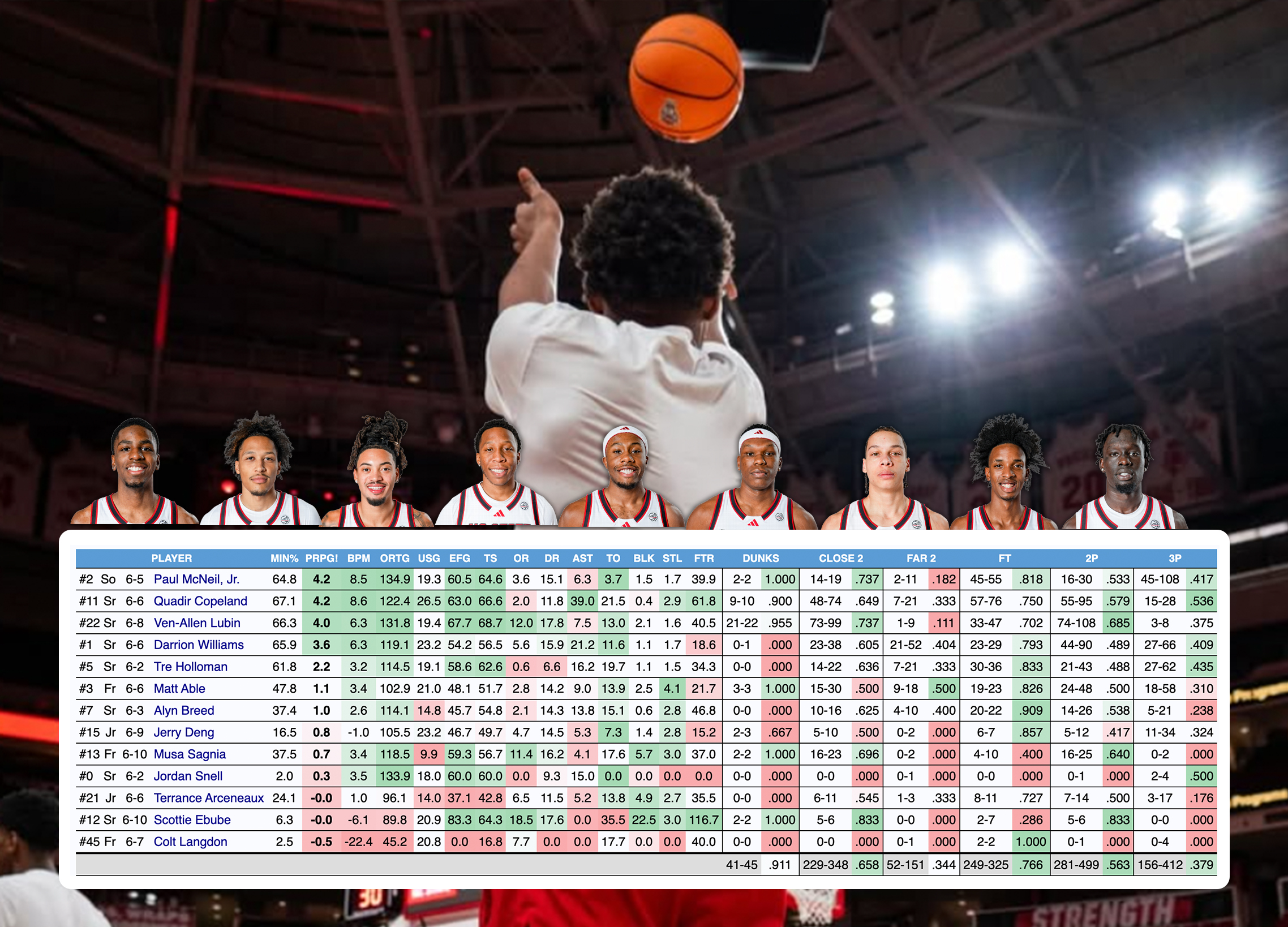
+8.6 Quadir Copeland
+8.5 Paul McNeil Jr
+6.3 Ven-Allen Lubin
+6.3 Darrion Williams
+3.4 Matt Able
+3.4 Musa Sagnia
+3.2 Tre Holloman
+2.6 Alyn Breed
+1.0 Terrance Arcenaux
Now those numbers are good, but there is a big difference between playing a team like Virginia or Kansas vs. a team like UNCG or Texas Southern. Some of these guys are feasting on smaller, weaker competition, which is boosting this number.
Let’s look at this same stat, but let’s scope it to…
VS. TOP-50 COMPETITION
(Kansas, Seton Hall, Boise St, Auburn, Virginia – NC State is 1-4 in these games)
+5.9 Tre Holloman
+4.9 Terrance Arcenaux
+4.5 Quadir Copeland
+3.1 Darrion Williams
+2.9 Alyn Breed
+2.6 Ven-Allen Lubin
+1.3 Paul McNeil Jr
+1.9 Matt Able
+1.0 Musa Sagnia
Very interesting, right? This is a totally different ranking, and I’m not so sure this ranking is matching up with the minute distribution we’re seeing.
NC State has only lost one game outside of Torvik’s Top-50 (Texas, which is 51). So, really, there isn’t an issue there. It’s when you get to these Top-50 teams that NC State is having an issue breaking through.
That’s why I think it might be worth taking a look at Top-50 output vs. minute distribution. At this point, 5 games in, you have a decent sample size. So let’s look at it.
AVERAGE MINUTES VS. TOP-50 TEAMS
32.2 Ven-Allen Lubin
31.5 Holloman (did not include UVA bc of injury)
31.4 Darrion Williams
30.0 Quadir Copeland
24.6 Paul McNeil Jr
20.0 Matt Able
15.0 Alyn Breed
13.6 Terrance Arceneaux
9.4 Musa Sagnia
Are there any inconsistencies?
Well, the biggest one is the most shocking (but something we noted a few weeks ago), is that Paul McNeil is struggling mightily vs. Top-50 0pponents, but obliterating everyone else.
Here is the most used lineups vs. Top-50 opponents to this point…
Copeland
Holloman
McNeil Jr
Williams
Lubin
But the data scoped to Top-50 opponents says it should look more like this…
Copeland
Breed
Holloman
Williams
Lubin
In the “Finding Balance” article we looked at above, we suggested that the data suggested this lineup was the one giving NC State the most value vs tougher teams. Now, you could argue that Arcenaux with his 4.9 BPM in Top-50 games should get the nod over Breed, but he has a flagged ‘outlier’ that is boosting his ranking here.
He’s had a negative BPM in every Top-50 game outside of Boise State, where he had an insane +20.7 BPM that game. No one on this team has had a higher single game number better than that in Top-50 games. That is boosting him into the #2 slot.
But it shouldn’t be totally insignificant. It goes to show that if Arceneaux can get his offense going, he can be a true difference maker. That’s what this staff was banking on when they signed him. That game he went off vs. Boise St. is the only time NC State dominated a Top-50 opponent.
So what does this all mean, and how could the staff be using this information to tweak strategy going forward?
Well, this is just one metric, and there are so many other variables, but BPM 2.0 from Torvik does do a really good job of giving you an idea of who’s playing winning basketball. So, if that’s what Wade is leaning on to back up Williams, it must mean something.
That said, I think there are some tough decisions to be made.
You need Paul McNeil Jr. to become a force. He’s a hard worker, he does everything right, he’s a game-changer when he gets hot, and you need to keep him sort of happy to keep him around next season. But this is a win-now scenario, and against Top-50 teams, McNeil has been just ok. Defenses are taking away the 3, and it’s limiting his offensive impact and defensively he hasn’t been great in these games. But, he’s a microwave shooter and you have to try to get him going. I think the question is when do you pull the plug and when do you sub out his potential offense with some guaranteed defense? That may be a slight shift we see.
Meanwhile, Tre Holloman (whose tweaked ankle may change things) has been a little more multi-dimensional and has actually played best against Top-50 teams. He needs to be in there, and to Wade’s credit, he has been despite some early questions about shot selection.
As stated before, you can look at Arcenaux’s game against Boise St. as a ceiling, and try to get him back there. They tried to give him minutes vs. UVA, but he put up a negative BPM. I guess you keep trying to integrate him, hoping things eventually click. If he can get even CLOSE to that type of performance, it’s a game-changer because his defense is so good and his length is so disruptive.
Breed’s 2.9 BPM vs. Top-50 teams is nice, but there are caveats here as well. His 4.4 defensive BPM vs. Top-50 is best on the team and has been great since he got thrown into the rotation, but offensively, he hasn’t given NC State much. His Offensive BPM vs. Top-50 is -1.6.
Then you have Lubin and Williams, both of whom have to be on the court based on roster construction and what they bring to the offensive side of the floor, but both have NEGATIVE Defensive BPM vs. Top-50 and that’s hurting NC State.
Lubin’s is -.5 and Williams is -.3 vs. Top-50. This is an issue. NC State front line is defensively weak. This is why you see them sending doubles, which leaves open shooters. It’s causing a domino effect. So how does Wade deal with this?
Is your mind boggled yet? It should be because this is a complex puzzle that Wade and his staff have to figure out.
The roster is your roster, but you definitely have guys performing under the level you expected and it’s causing some kinks in the initial strategy.
So they’re seemingly trying to fix the plane while it’s flying and there have been ups and downs.
We’ll see how they balance this stuff, but after watching how Missouri just made #22 Florida look bad using a sporadic zone defenses to cover some of the flaws they’ve had this season, you have to wonder if that’s the next step for NC State.
Say you have, Williams, Lubin and McNeil on the floor together. All guys that have negative Defensive BPM, but positive Offensive BPM (vs. Top-50 opponents). Maybe you hide them in a zone vs. certain Top-50 opponents?
But when you have guys like Breed or Arcenaux on the floor, and when you have Sagnia in for Williams or Lubin, you can go man vs. anyone. In fact, against non Top-50 opponents, when NC State is able to give more minutes to Sagnia, their defense goes from good to GREAT. But against Top-50’s Sagnia’s minutes dip because of he’s got one of the lowest offensive BPM on the team…and that’s when the defense feels so slow and leaky.
You’ll have to figure out what to do when you have to have those lineups mixed, but there’s certainly an equation that can weight this one way or the other and certainly one the staff is already looking at.
A couple of unexpected wrinkles here and there can help you win a possession here or there, and most of these ACC games end up being 2 to 3-possession games at the end of the day.
Or heck, maybe you keep doing what you’re doing and hope things shift. Maybe the deeper you get into the analytics, the more you lose the human element of “Just go out there and win.”?
I don’t know, I’m just parsing out stats to give you perspective and show you the complexity of the rotation decisions.
What do you think?







 NC State Baseball4 days ago
 NC State Football3 days ago
 NC State Basketball4 days ago