Over the next few days, we’ll be focusing in on the transfers that NC State brought in via NIL to see what the ‘Return on Investment’ was during the REGULAR SEASON. To do this, we will look at their stats from last year and compare them to this year, while overlaying perceived expectations and role adjustments. (Note: There is still one game and a full postseason to be played, so these numbers and outcomes can change. This is just a check-in with the regular season nearly finished and the last full week of open-air time before the news cycle is dominated by ACC Tournament and NCAA Tournament coverage.)
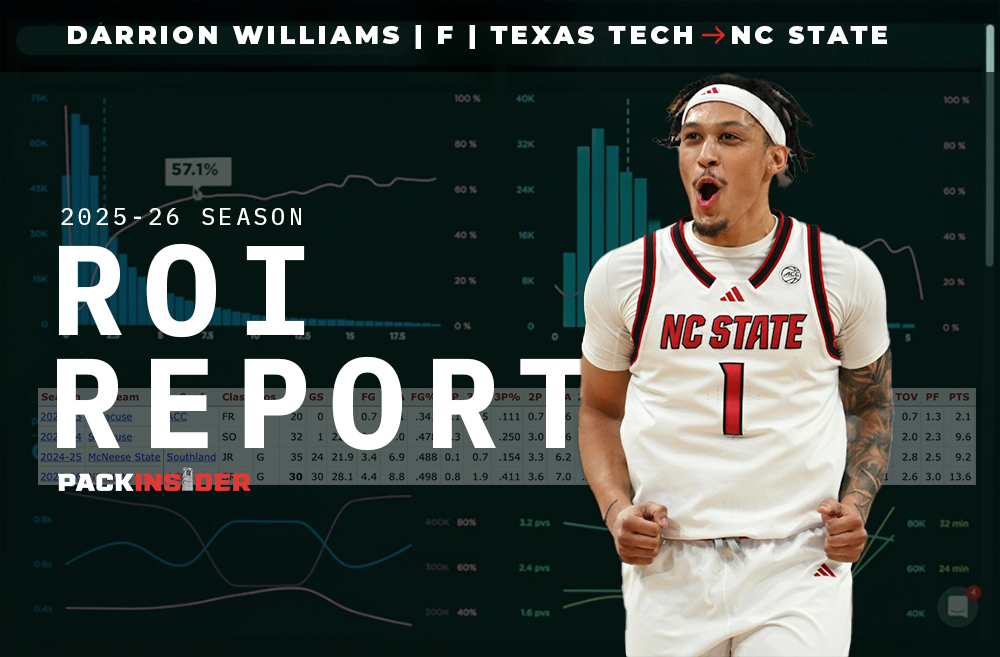
Let’s take a look at Darrion Williams.
Williams came to NC State via Texas Tech, where he was the 2nd best player on a team that made an Elite Eight run. He took time to work out for NBA teams to see if that route was an option before returning late in the portal process and being courted by Will Wade, who had taken the NC State job and was without an elite front-court piece. Williams joined the Wolfpack on March 22nd of last year to a ton of fanfare, with hopes that he would help NC State launch its next chapter under Will Wade.
Expectations:
Let’s not beat around the bush. The expectations for Darrion Williams were massive.
But let’s also not pretend NC State as a program doesn’t come with its own baggage. The Jimmy V firing led to sanctions. The sanctions tanked the program. That collapse opened the door for UNC and Duke to become the darlings of the ACC, a conference NC State helped build in the first place.
Then, after the fanbase finally got a taste of real success again with Kevin Keatts’ Final Four run in 2024, Wolfpack fans were itching to get back to national prominence. The hiring of Will Wade brought that hope rushing back. But for Wade to pull it off, he needed elite players, and Darrion Williams just happened to be the guy who stepped into that role.
I think Wade’s desire to change the culture and give the fans what they’ve been craving, combined with his belief in himself and his track record, led him to ramp up the hype to levels we hadn’t seen around here in decades. It was exciting. It got NC State fans believing again. And whether people agree with it or not, he played it exactly how a coach in his position probably should.
But this isn’t LSU. Basketball at NC State is part of the university’s identity. The passion for it runs deep and it has for generations. A lot of that passion has been dormant for years. From the outside, people see a passionate fan base, but they are only seeing a small part of what’s really there.
When you wake up that kind of interest and hope, you also wake up the passion that comes with it.
And once that happens, NC State basketball lives under the microscope every single day across the Triangle.
All of that context matters when talking about Darrion Williams. Whether he wanted it or not, the savior label was placed on him by the fanbase. With that label came the scrutiny, and that scrutiny was always going to be part of the deal.
Williams was expected to walk in and lead this new group of mercenaries. The mission was simple (sarcasm): erase more than 40 years of frustration and put NC State basketball back where the fanbase believes it belongs.
Fair or not, that is a lot to place on the shoulders of a 22-year-old. Especially one who had never truly been the face of a team at this level before.
And whether people want to admit it or not, that weight changes the way every performance gets judged.
Year-Over-Year Stats
Minutes Per Game
Last year at Texas Tech: 30 🔴
This year at NC State: 29.5
Points Per Game
Last year at Texas Tech: 15.1 🔴
This year at NC State: 14.4
Assists Per Game
Last year at Texas Tech: 3.6 🔴
This year at NC State: 2.8
Rebounds Per Game
Last year at Texas Tech: 5.5 🔴
This year at NC State: 4.8
Steals Per Game
Last year at Texas Tech: 1.3 🔴
This year at NC State: 1.1
Field Goal %
Last year at Texas Tech: 44% 🔴
This year at NC State: 42%
3pt Field Goal %
Last year at Texas Tech: 34%
This year at NC State: 39% 🟢
Usage
Last year at Texas Tech: 27%
This year at NC State: 25.6%
(Not rated better or worse – subjective stat)
Outcome:
Say what you want, but Williams’ performance this regular season has mirrored the team’s performance. It’s been really good, just not quite as good as everyone expected (including Wade). Whether that’s fair or not is up for debate.
NC State was betting on Williams to step out from under JT Toppin’s shadow at Texas Tech and shine on his own. And this wasn’t just the view from Wade and his staff. This was the view across college basketball. Darrion Williams was seen as a guy with another jump in him, someone who could go from sidekick to superstar with more volume, more usage, and a bigger spotlight. That’s why Williams was the preseason ACC Player of the Year and appeared on lists as a potential national player of the year.
NC State bet big on that upside, and based on the numbers, it wasn’t an unreasonable bet.
Williams had an absolutely elite sophomore season at Texas Tech two years ago. He posted career highs across the board: 33 minutes per game, nearly 50% shooting from the field, and an elite 46% from three. He averaged 7.5 rebounds and 2.5 assists per game. But he was a lower-usage player with just a 17% usage rate, and he was a relatively low-volume scorer at 11.4 points per game.
The first red flag might have been last year, his junior season, when his usage jumped ten points to 27% and his efficiency dipped. His field goal percentage dropped to 44%, his three-point shooting fell to 34%, and his rebounds declined by two per game to 5.5.
But hindsight is always 20/20. The increased usage did bump his assists from 2.5 to 3.6 per game and his scoring from 11 to 15 points per game. While the added responsibility nudged his efficiency down, Texas Tech still found success and made a deep run, eventually losing to Florida in the Elite Eight.
That left a lingering question. How much of Williams’ success was tied to JT Toppin’s dominance?
In other words, if Texas Tech had not been very good and Williams’ numbers had dropped with increased usage, the narrative probably would have been different. But the Red Raiders were excellent. That success helped fuel the belief that Williams still had another level to reach, and that some of his potential had been capped by Toppin’s dominance and high usage rate.
From NC State’s perspective, it was a bet worth making. They paid a lot to find out, and you can argue that several variables are in play here. But through the ACC regular season, Williams simply has not shown the elite upside everyone was banking on. With nearly identical usage and no JT Toppin beside him, his numbers have seen a slight statistical regression.
To be clear, this is not some bottoming-out scenario. Williams is still very, very good. He is leading the team with 14.4 points per game. He is second in rebounding at 4.8, second in assists at 2.8, third in steals at 1.1, and shooting 41% from three. That is why the Williams conversation is so complex. A lot of it comes down to framing. A lot of it is about outside perception and expectations. And a lot of the expected value tied to him is being measured against his NIL market price.
Is that fair? I honestly do not know. And that uncertainty is part of what makes the conversation so interesting.
On the surface, this is about Darrion Williams. Underneath it, though, is a much bigger debate about NIL culture and how money brings expectations and scrutiny to what are still college kids.
Darrion did not necessarily ask for all of this. However, by accepting NIL money, he does in some ways accept the reality that comes with it. That is the world we are living in now. These athletes are accepting money that adults worked long hours and sacrificed family time to earn. They are accepting dollars that could be used to feed a family or pay off someone’s mortgage.
When you look at it that way, this is not simply free money to play basketball. It comes tied to expectations and results. Fair or not, these players are learning that reality early.
So yes, ROI, once just a business term, now sits quietly beneath the surface of almost every conversation about NC State basketball.
It is a difficult topic because these are young players who just want to play basketball and do their best. But this is the landscape now. I did not create it. I am simply trying to weigh in on it and put it in perspective.
With all of that said, we eventually have to get to the central question. ‘Has the ROI on Darrion Williams been good for the Wolfpack during the regular season?’
The honest answer, from the perspective of fans and donors, is probably not.
And as a human being, I don’t enjoy writing that. This is a college kid who has gone out and battled for this team. He has taken hits, played through injuries, and he has not mailed it in. He is competing despite the noise, and there is no doubt that noise weighs on him. I hate that for him, because at the end of the day he did not fall in love with this game because of money. He fell in love with it because he loves the game.
But the new system has complicated that in ways we are still trying to understand. A court ruling designed to help players, but without much nuance or guardrails, has created a world where conversations like this are unavoidable, where that ‘love of the game’ gets tarnished by money. And yes, that’s life in a capitalist society, but man, I wish we could protect that ‘love of the game’ a little bit longer, and by doing that protect the purity of college sports.
Anyways, let me get off my soapbox.
Back to Darrion.
The good news is that we are writing this near the end of the regular season. And while these games matter, college basketball teams are ultimately defined by what they do in March. NC State’s final chapter has not been written yet, and neither has Darrion Williams’.
He still has every opportunity to change this narrative with a strong finish to the season. Every State fan is rooting for him to do exactly that.
Because if NC State makes a late run and Williams is at the center of it, everything else from this season will fade away, and the ROI conversation will look very different.
Just look at the Final Four team from a couple of years ago. That group finished 10th in the ACC. DJ Horne and DJ Burns were one Michael O’Connell buzzer-beater away from being remembered as transfer portal busts. Instead, they became legends whose highlight reels will play in Raleigh every March for years to come.
And that’s the beauty and the chaos of college basketball in March. Narratives change fast, legacies are written in a matter of weeks, and one great run can make everything else irrelevant. Let’s hope Darrion Williams is the next in line to find this out.






 NC State Basketball3 days ago
 Basketball Recruiting3 days ago
 NC State News3 days ago