The Carolina Hurricanes’ arrival in Raleigh in 1997 marked the beginning of major-league sports in the Triangle and helped transform the region’s identity. While the story often focuses on the Hartford Whalers’ relocation and their owner, Peter Karmanos, a crucial but somewhat unknown factor was North Carolina State University’s dream of a new basketball arena.
Remember, it was controversial at the time. NC State was leaving the storied Reynolds Coliseum, where most of its history was made. But with Research Triangle Park attracting more and more new corporations, which brought more and more new workers, there was a need and a market for entertainment. Because of that, there was motivation to attract pro sports.
The plan was simple. Build an arena that could house basketball, hockey, arena football, and concerts. Then, team up with NC State, which was looking to create more revenue with more seating, more boxes, a recruiting advantage, and a more modern basketball experience.
It made a lot of sense on a lot of different fronts. There was a risk in spending this much to build an arena, but with NC State guaranteeing to fill it for the entirety of the basketball season, that risk was offset to an extent, making it feasible.
But make no mistake, without NC State’s push for a new venue, the then-named ESA (Entertainment and Sports Arena) would likely have never been built.
The Wolfpack’s Long Quest for a New Home
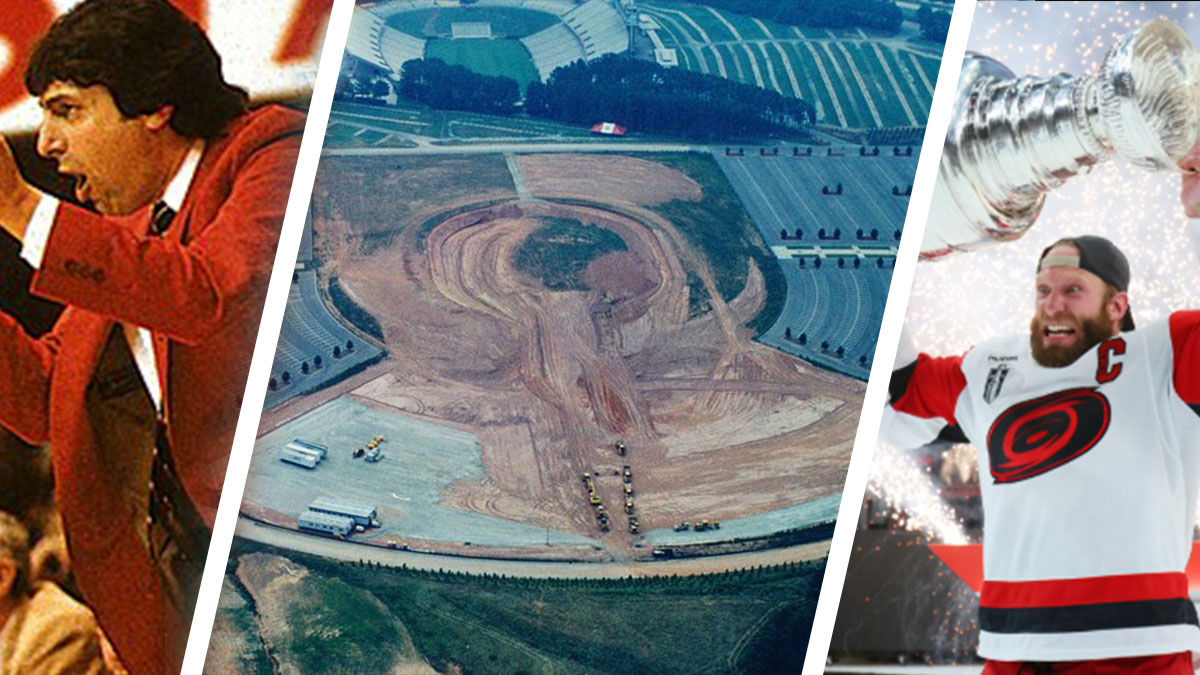
NC State’s men’s basketball team had called Reynolds Coliseum home for decades, but by the 1980s, it was clear the aging facility was becoming outdated. Legendary coach Jim Valvano was one of the first to champion the idea of a new arena. In 1989, the NCSU Board of Trustees approved plans for the arena.
Progress was slow. There were funding challenges, leadership changes (including Jimmy V’s departure), and logistical issues that stalled the project.
In 1995, the North Carolina General Assembly finally created the Centennial Authority, a public entity to oversee the arena’s development and operations. This was initially framed around NC State’s basketball needs but was quickly reimagined as a multi-use facility capable of hosting concerts, events, and potentially a professional sports team. Financing involved a mix of state appropriations, contributions from Raleigh and Wake County (via hotel and restaurant taxes), university cash, and, later, some private investment.
Enter the NHL: The Whalers Find a Landing Spot
Raleigh had explored NHL expansion, but a lack of a suitable arena was the major obstacle.
So they decided, with time running out, they would focus on minor league hockey. And they were close to that becoming a reality, until fate reared its head.
Peter Karmanos, owner of the Hartford Whalers, faced arena issues in Connecticut and gambled that his relocation threats would eventually get him a new stadium. He tried to call their bluff and announced he was leaving for another market (yet to be named), but when they didn’t budge, he was the owner of a team with no home.
Karmanos didn’t have many options. He needed a viable market with a ready-made stadium, and he needed it fast. He decided on Raleigh after learning about the arena project, and in 1997, he announced the team’s relocation to North Carolina, rebranding to the Carolina Hurricanes.
The Hurricanes played their first two seasons (1997–99) at the Greensboro Coliseum while the Raleigh arena was being completed. Construction officially began in July 1997 (with a second groundbreaking), and plans were modified to meet NHL standards, adding features like league-standard locker rooms, pro-level corporate suites, a dehumidification system, and ice capabilities. This retrofit came with a massive cost increase.
Karmanos and The Hurricanes chipped in quite a bit, around $40 million (way more than initially planned), toward upgrades, while the total project cost reached approximately $158 million. The state contributed $18 million, with additional funding from local governments and other sources. Meanwhile, somehow NC State retained scheduling priority for basketball games.
The arena finally opened on October 29, 1999. The Hurricanes hosted the New Jersey Devils in the first event. NC State played its first game there shortly after, on November 19, vs. Georgia.
The venue became a shared home for the Canes and the Wolfpack, replacing Reynolds Coliseum after 50 years. This partnership was baked into the design and governance from the start. The Centennial Authority owns the building and land, with the Hurricanes handling day-to-day operations under lease agreements.
Why NC State Played Such a Big Role
NC State’s long push for a new arena created the momentum and public backing that made the whole Whalers-to-Raleigh move possible in the first place. If the Wolfpack hadn’t been fighting for a modern facility, it’s pretty unlikely the Centennial Authority or that multi-purpose arena would’ve ever gotten off the ground. Without a big venue already in the works, Karmanos probably never would’ve picked Raleigh. The public-private funding model and the design that works for both college basketball and pro hockey? That all came directly from the need to serve both NC State and the Hurricanes.
The relationship hasn’t always been perfect; there’ve been scheduling conflicts, fights over renovations, and the usual headaches with shared parking and logistics around Carter-Finley Stadium (we just addressed that with the fanbase calling for a watch party at The Carter). But it’s lasted over 25 years and is still going strong.
That said, this whole story almost ended early.
Despite winning the Stanley Cup in 2006, the Hurricanes’ attendance numbers nearly bottomed out in 2016 after a long stretch of poor seasons. The attendance got so bad that it was lower than when the Whalers left Hartford for Raleigh.
It seemed like this was the end as there began to be talks of relocation.
Tom Dundon’s vision + NC State’s culture created the ‘perfect storm’
In 2018, Tom Dundon purchased a majority stake in the Hurricanes for $420 Million. He inherited a struggling franchise in a non-traditional hockey market, with a unique partnership with a local university.
But under Dundon’s ownership, the Hurricanes became one of the NHL’s model franchises. The team returned to consistent playoff contention, attendance surged, and the once-mocked “non-traditional” hockey market transformed into one of the league’s loudest and most passionate environments. The rise of the “Caniacs,” sold-out playoff games, and nationally recognized tailgating culture (borrowed from the neighboring Wolfpack and made possible by NC State’s demand for spacious parking lots around Carter-Finley for football tailgates) helped establish Raleigh as a legitimate hockey town and is now the home of the 2026 Stanley Cup champions.
Think about it. In a roundabout way, NC State helped a little bit in bringing this Stanley Cup to Raleigh.





 Football Recruiting3 days ago
 NC State Basketball3 days ago
 NC State Baseball3 days ago
 NC State Baseball3 days ago
 Football Recruiting3 days ago