
NC State Football
FOOTBALL FILM ROOM: The Secret Behind NC State’s Run Defense

This article is part of a new a collaboration with ‘Trinity Road Times, ‘ an NC State site that focuses on in-depth analysis and dissecting the x’s and o’s. Stay tuned for more of their coverage here at Pack Pride. And if you enjoy analysis like this, check out the Trinity Road Times Member Chat for more.
———
Football is a game of numbers, space, and leverage, and every defensive coordinator in the game takes on the challenge of best distributing their numbers. For NC State Defensive Coordinator DJ Eliot, that often means two-high safety structures, which create a stronger roof on your defense at the expense of hats (guys) in the box to stop the run. Eliot wants to be a quarters coverage team, and everything on defense is related. Your coverage dictates your ability to fit the run and vice versa, and State must manage a light box if it wants to build its defense this way. Truth be told, it was kinda good at the run fit part last year.
Before we get started, let’s de-jargon a bit.
When I say run fit, all that means is the way a defense assigns responsibilities against the run. In the most traditional sense, every player involved has a gap, and their job is to “fit” that gap to block all running lanes. Simple enough, right? We wish.
Run fits are actually among the most complicated things in the game. There are so many ways to do it and so many inputs required once you get to a high enough level that you can start adding complexity. NC State is a great example of this, because it fits the run with a light box a lot of the time. As soon as you start doing that, you have to open the toolbox, because you’re at a numerical disadvantage.
Here is NC State’s defense against a single tight end (11 personnel) set from Florida State. The Noles have six players on the ball here when you add the tight end to the five offensive linemen. Six players means seven gaps. To be gap sound, NC State must have seven players in the box to match those gaps.
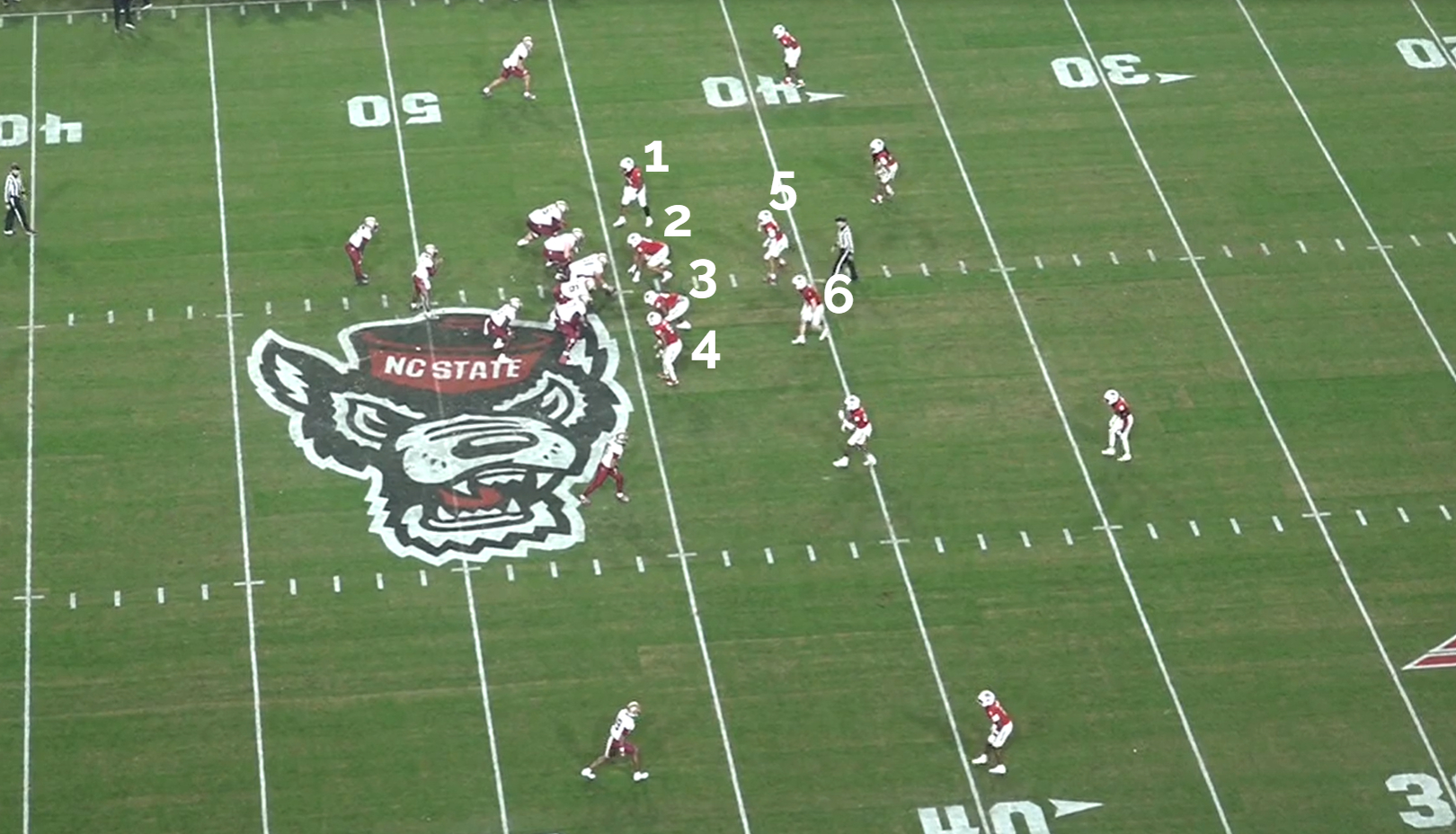
There are only six, because NC State is in an offset two-high safety coverage shell. This defense plays a lot of quarters, which forces you into a lot of these light box situations, and there is no advantageous way to fit the run down a man. Obligatory: Nick Saban’s famous quote on this . . .
“I want it written on my tombstone, cover 2 run fits put me here.”
That doesn’t mean you can’t be a great run defense that plays light boxes. It just means you have to have an answer for being down a man. You have to find a way to steal a gap. Oftentimes, this looks like trying to force runs outside, where players outside the box area can hunt it down. This is what NC State does with a couple concepts that fall under a category called ‘read stunts’.
* Read Stunts are tools used by defensive ends to change responsibilities and “fits” based on the type of play the offense runs. We’re going to look at two here. These are by no means the only tools DJ Eliot uses.
Jimmy and Pony Stunts
The Jimmy stunt is a speed-based read stunt that asks an edge player to read the offensive tackle’s movement and adjust their responsibility accordingly. Here’s how it works. Let’s pretend that Cian Slone has a jimmy stunt called for him on this play.
Read offensive tackle
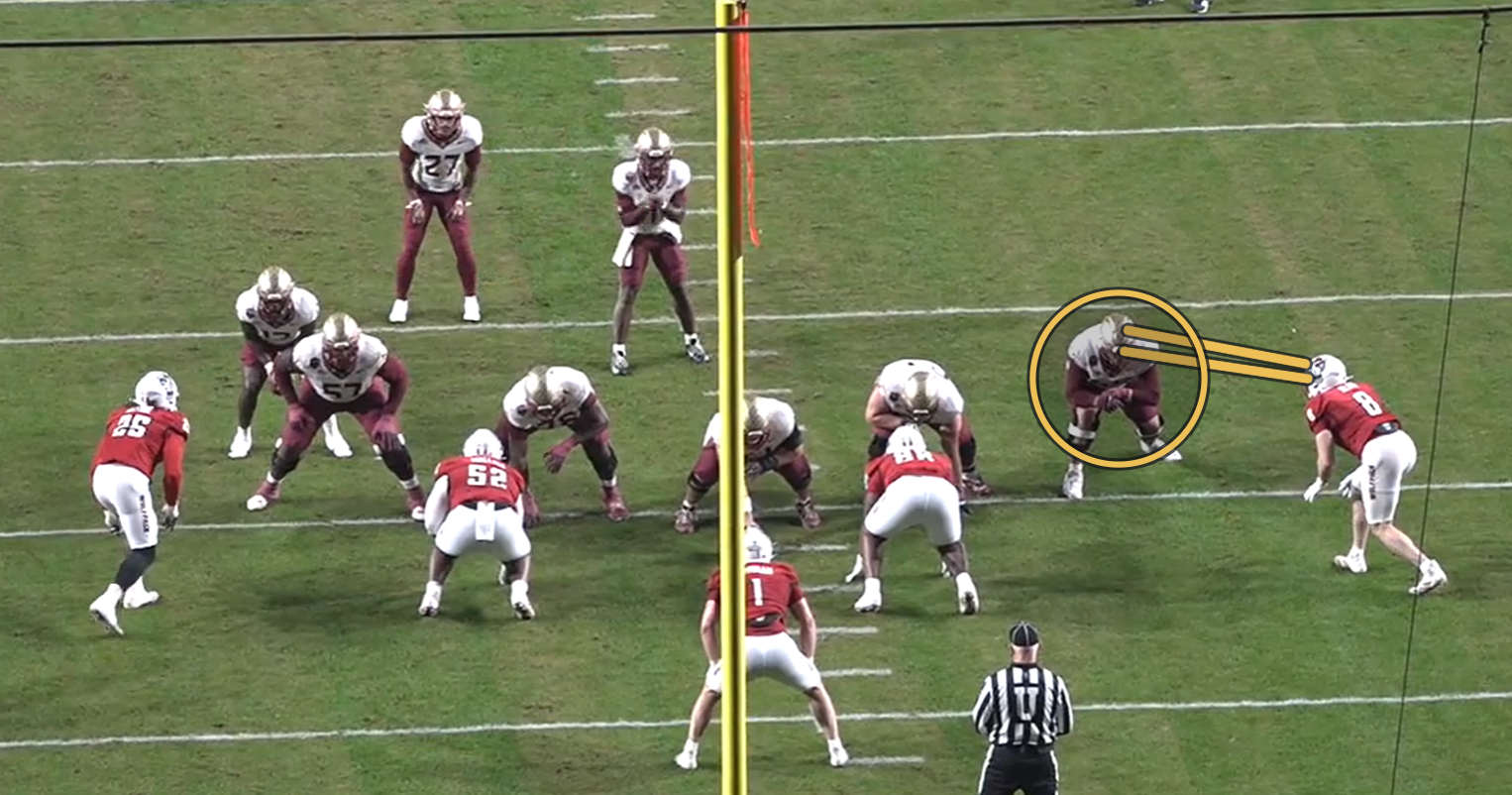
☝️ Slone is going to make a decision based on what the tackle does at the snap. This is called his “key.”
If he blocks toward me, slant inside of him.|
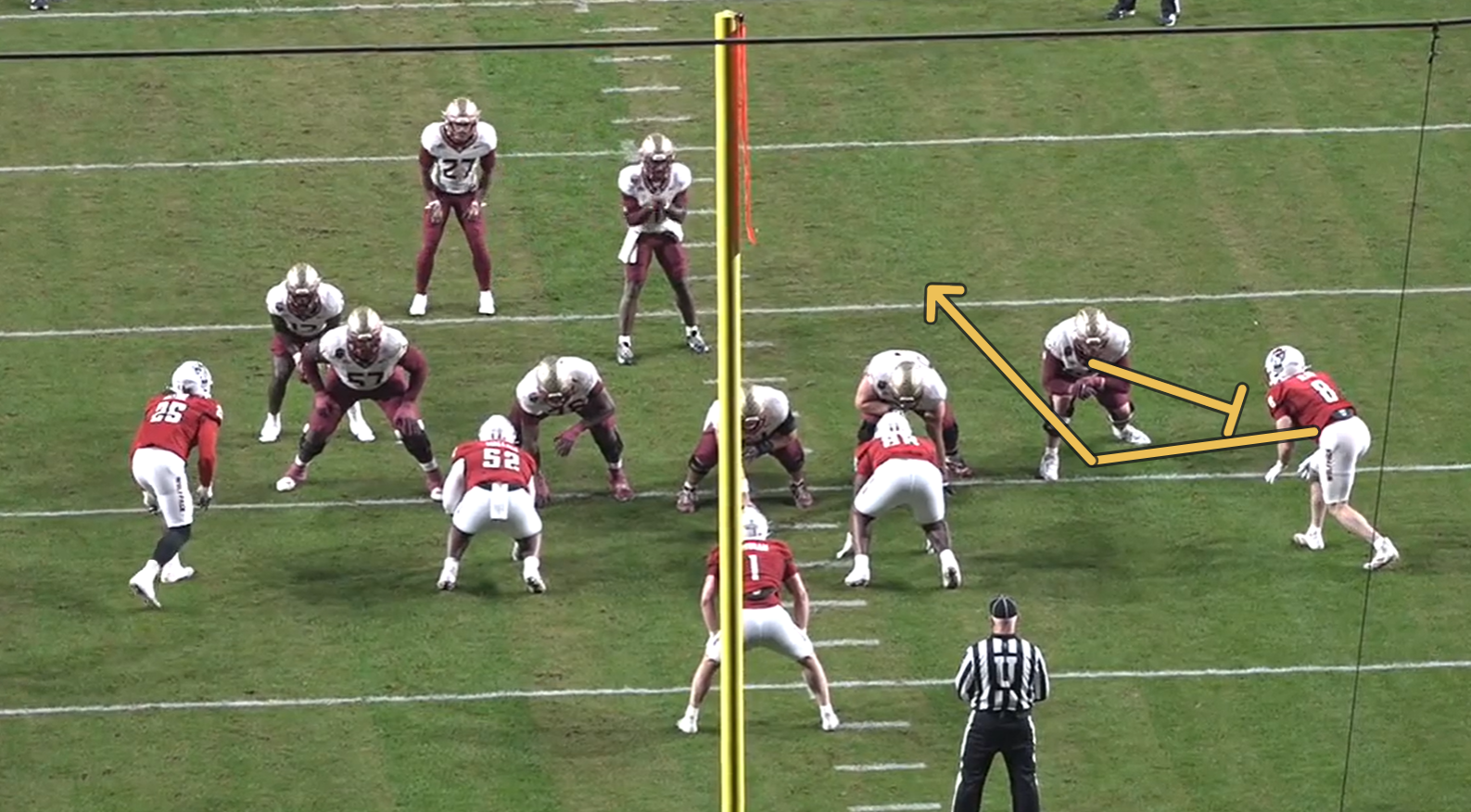
☝️ This type of blocking from the tackle likely means a zone run is coming your way, and the inside move is designed to flush the ball to the edge by fitting every interior gap on the offensive line.
If he blocks away from me, crash down the line toward the ball.
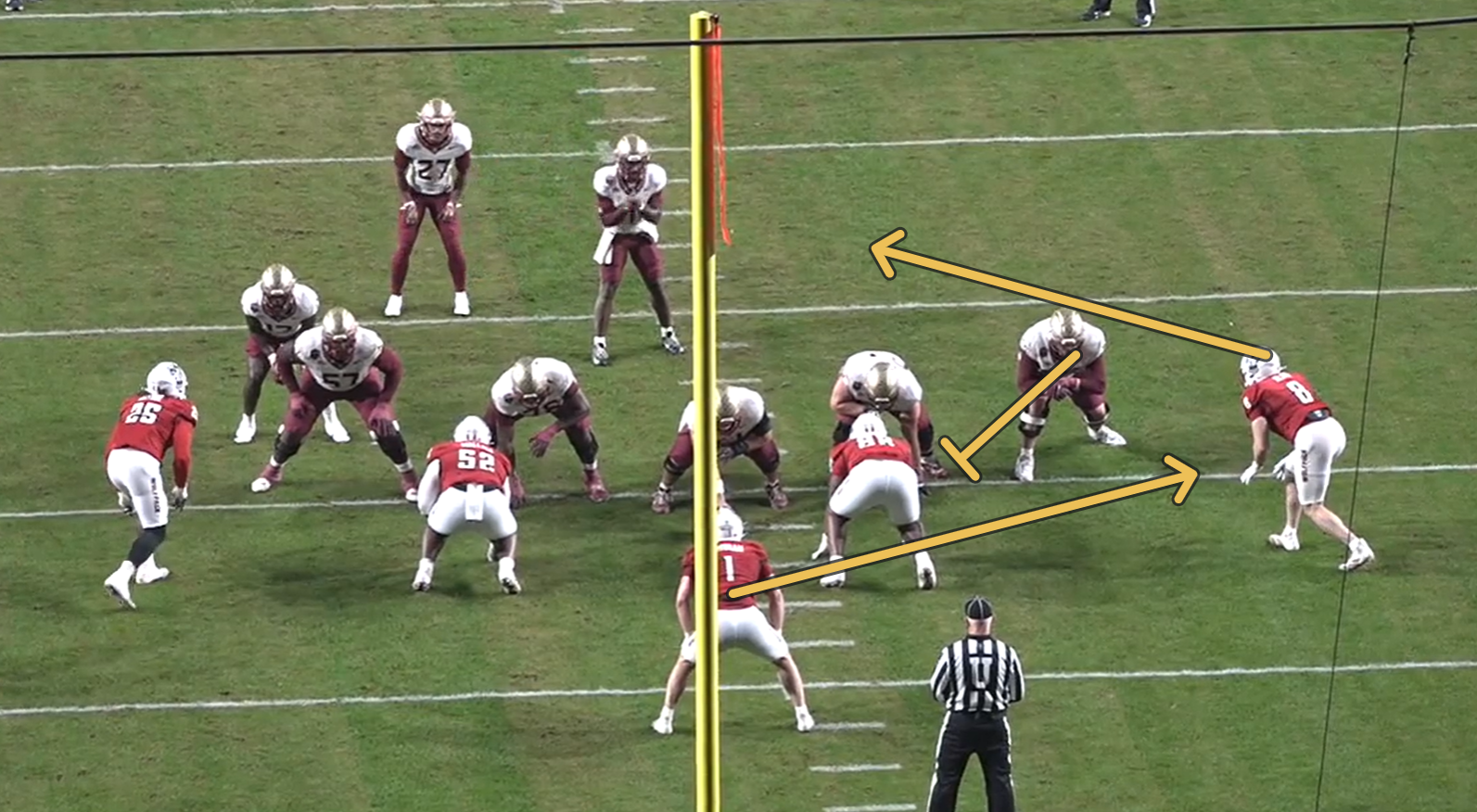
☝️ Blocking away often means there is a puller coming your way, and you can attack that and “dent” the kick out block. This is often accompanied by what’s called a scrape exchange to prevent an easy read option pull. I have drawn the scrape exchange above (you probably wouldn’t use Fordham like that here, but it’s drawn for effect).
If he drops back into pass protection, you are an edge pass rusher.
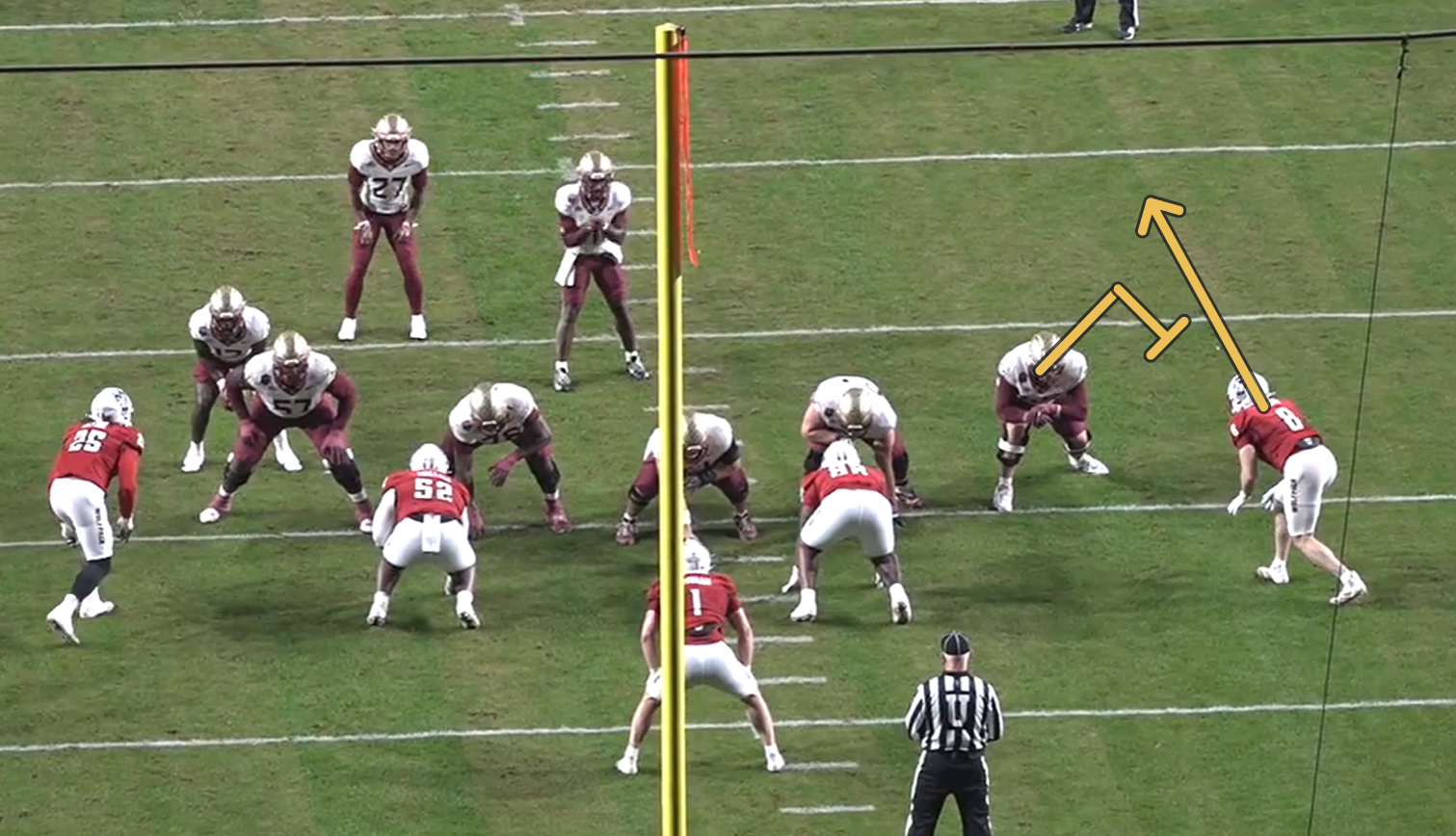
☝️ If he pass blocks, you are a contain pass rusher.
Here is an example from Cian Slone against a zone run.
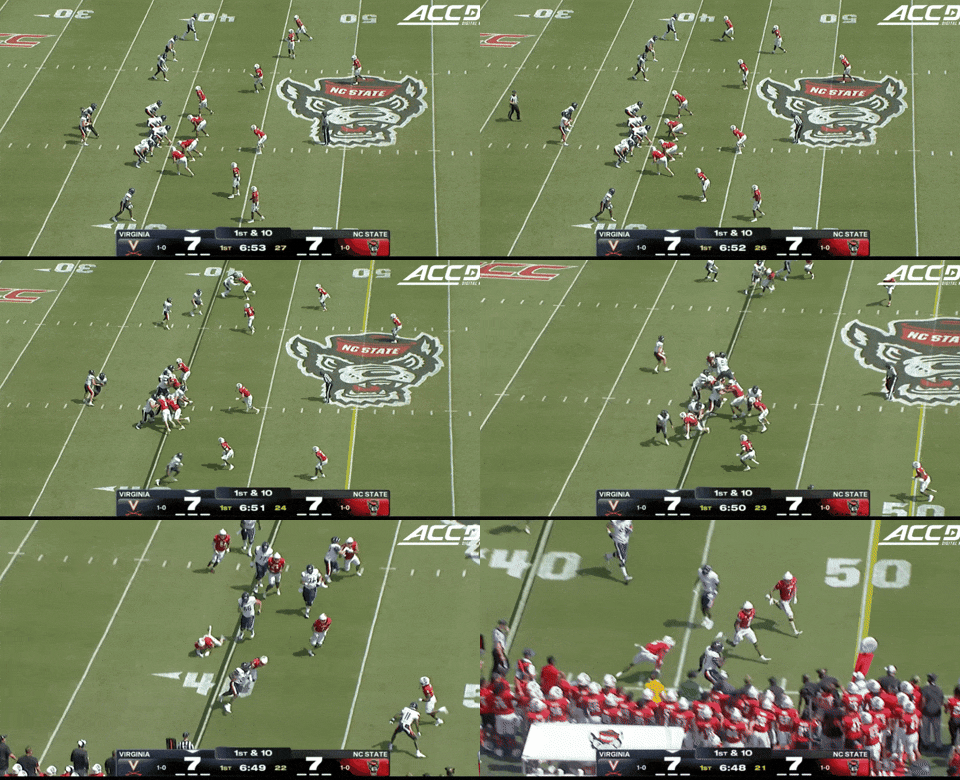
☝️ You can see Slone aligned outside the tackle before the snap. When the tackle steps to him, he shoots inside. It works perfectly, as he flushes the run outside to the boundary, where Ronnie Royal is waiting. Royal does a really bad job here and the run gets loose. You still have to execute!
A little football theory behind this. Open interior gaps are extremely valuable for offenses that want to run zone plays. The open B gap (space between the tackle and guard) is the foundational space that most spread offenses are built out from. Being able to cut off every interior gap and force zone runs outside is extremely beneficial. However, the downside of just sticking your edge player there presnap is that you limit pass rush and can be attacked by gap scheme runs like counter and buck sweep.
The Tony Gibson defense was built to clog the interior gaps, which is why that scheme is known as the spread killer. The myth about the 3-down front was that it was bad against the run. It was excellent against the run, but specifically the zone run and runs without tight ends. It never had a great answer for GH counter.
The jimmy and pony stunts attempt to get the best of both worlds there. Clog the inside gaps against zone, but keep a strong edge setter and outside pass rusher against other plays. This was a good concept for Cian Slone, who was quick guy that had a strong inside move anyway.
A pony stunt is the same thing as a jimmy stunt, but it involves the defensive tackle too. See below for a pony stunt.
☝️ Split flow zone play to the right (defense’s left). State has a pony stunt on. When the guard and tackle step toward them, Cleveland and Harsh both slant inside. QB pulls the ball, so we don’t get to see the result.
Heavy Technique
Very similar to the jimmy stunt, but not the same, is the heavy technique. The heavy technique carries similar rules, but is more suited for power-based players and relies on physicality. It is a two-gap technique where the edge player will align head up on the tackle (or tight end) instead of shaded or in a gap. They will then engage the tackle and rip inside if the ball is flowing to them. The function is the same as the jimmy stunt.
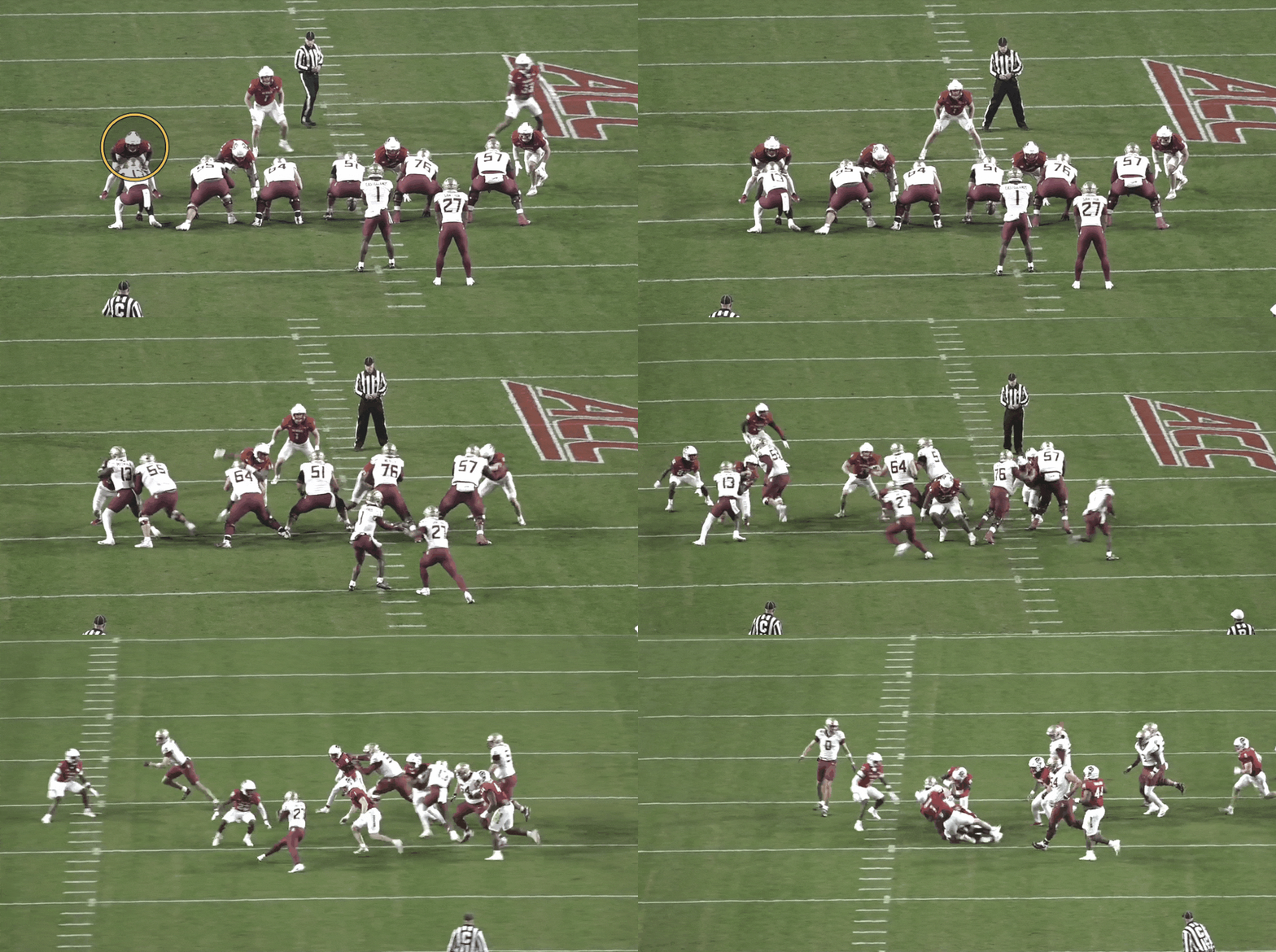
☝️ This is a heavy technique from Sabastian Harsh. Notice that he is lined up on top of the tight end, not left or right of him. When he gets the tight end stepping to him, he strikes him, gets eyes on the ball, and rips back inside to flush it out the front door. Jackson Vick, who is not in the box presnap, comes down to make the play. The heavy tech structurally is trying to push this ball to VIck.
This is very similar to jimmy/pony, and some people may even call them the same thing. The rules are basically the same, as is the theory behind it. Making a run go horizontal is generally bad for the offense. The longer it takes to get vertical, the more time support players have to get to the ball and chase it down. By clogging interior gaps, you can push the ball to players who don’t have to be in the box to participate in stopping the run. This reduces conflict for linebackers and defensive backs, which makes it harder to RPO certain defenders, all while maintaining an edge for the pass rush. These schemes are built to give players the ability to attack situationally and create versatility and fluidity within the scheme.
Stack-Track-Fallback
Stack-track-fallback (henceforth: STF) is a linebacker technique that helps create layers in the run defense. Linebackers have a gap in the run fit same as defensive linemen, but when you have more gaps than defenders, it’s beneficial to keep your linebackers in a spot where they can scrape across the formation and play multiple gaps.
Layering your run defense can hurt your TFL numbers sometimes, but it also creates a net over the point of attack that can capture the ball, which is beneficial when you have more gaps than guys. The linebackers are essentially playing the ball more than the gap. They are stacking on top of the defensive line, reading the ball, and making the tackle once the ball declares.
This is not NC State, but it is new NC State linebacker Popo Aguirre demonstrating the technique perfectly.
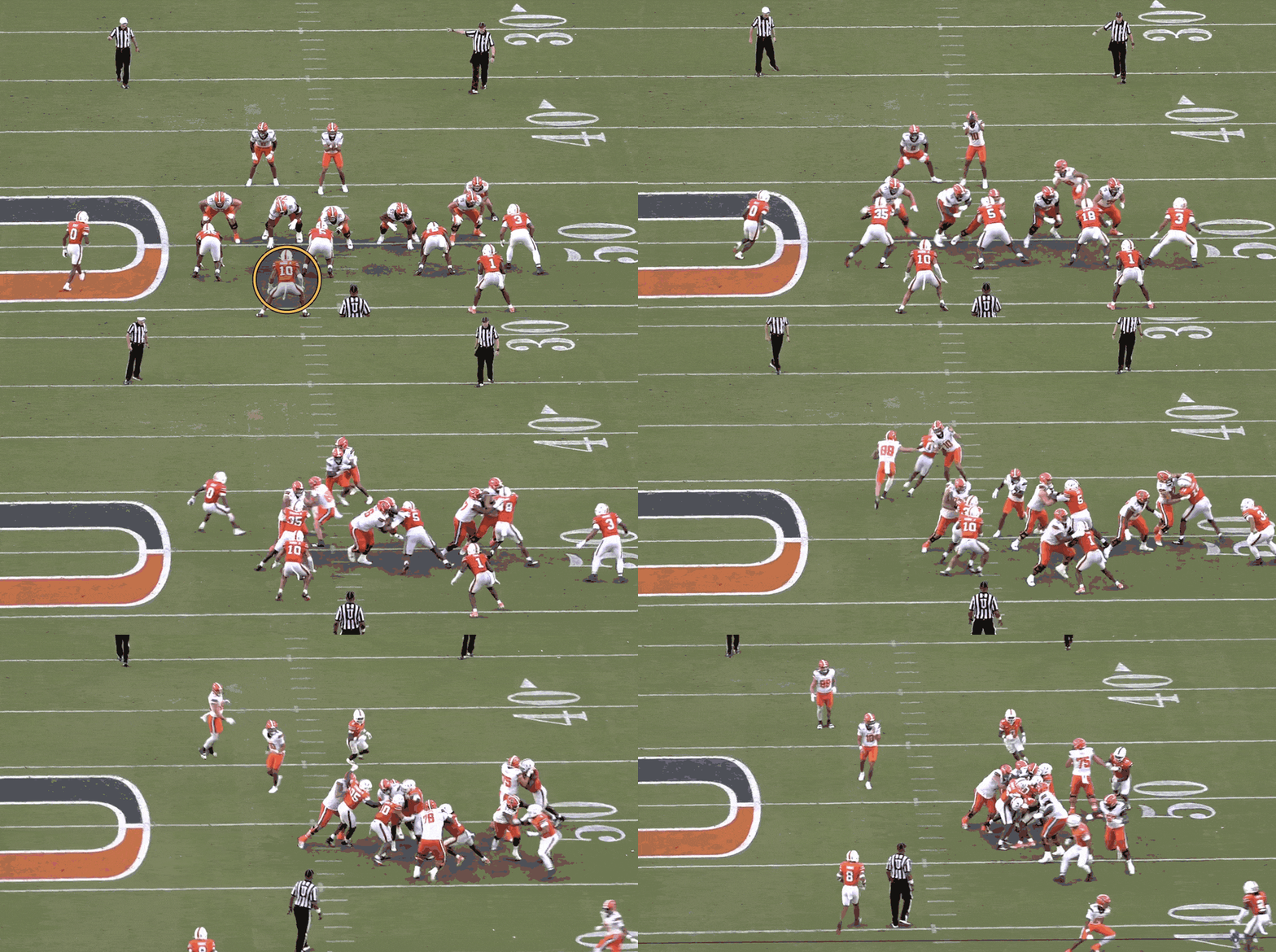
☝️ Watch 10 as he stacks up 35, reads the ball, and plays to it when it declares. If the ball cut outside of 35, Aguirre could easily work out there too. If this was a basic one-gap scheme, 35 would be playing into one gap and Aguirre would be running through the other one.
Here’s Kenny Soares demonstrating the value of STF against an outside zone play from Notre Dame.
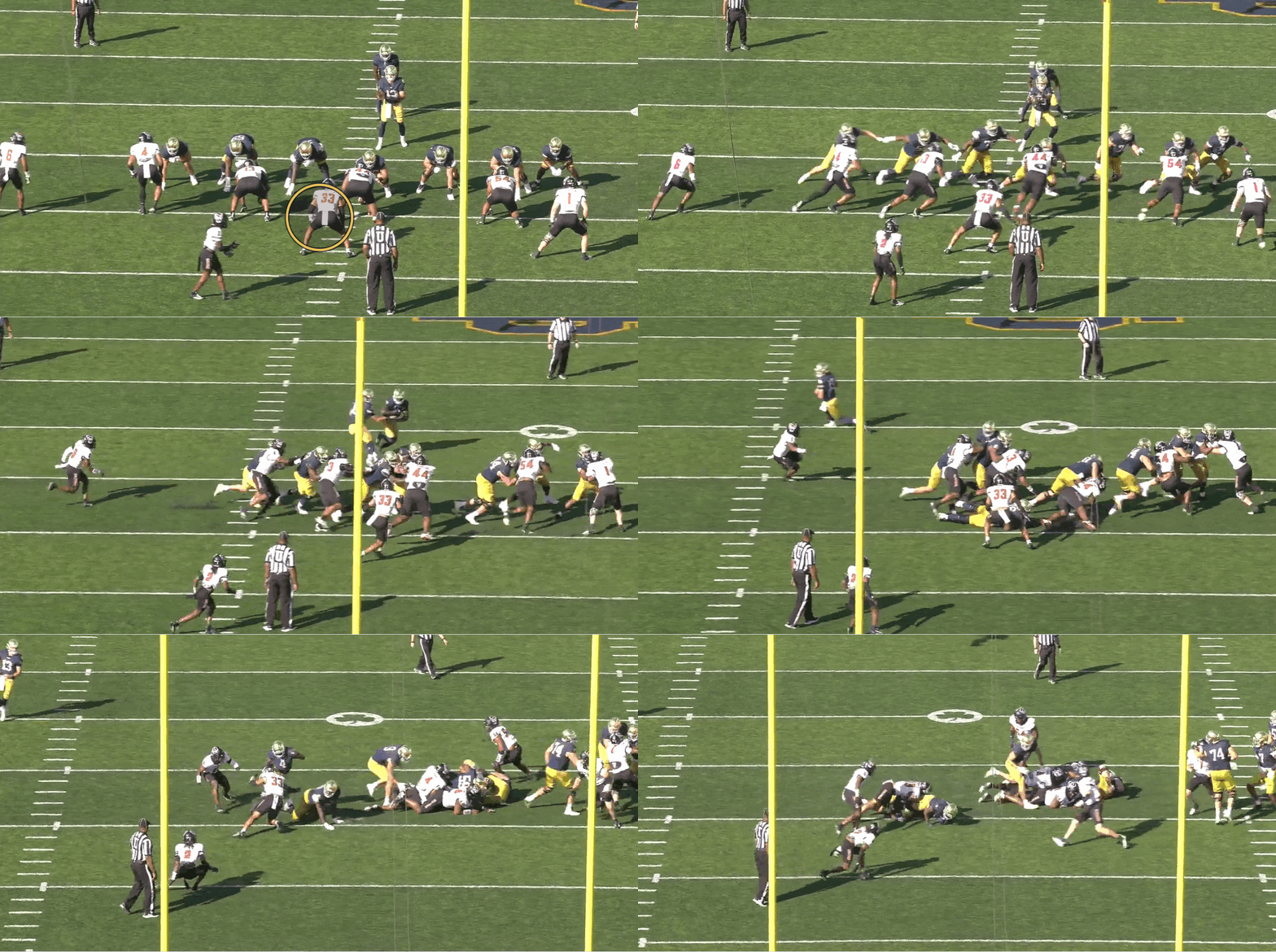
☝️ Soares’ main responsibility here from a gap perspective is the frontside A gap. Because he’s ball reading and layering here, he ends up making an important tackle on the complete other side of the play.
All these tools work together to create a system that can play split-field coverages and, if executed well, still be sound against the run. These are the kinds of things that will be asked of the likes of Harvey Dyson, Isaiah Shirley, Popo Aguirre, and everyone else involved in the run fit.
Enjoy analysis like this? Check out the Trinity Road Times Member Chat for more: https://www.patreon.com/c/TrinityRoadTimes



NC State’s Ryan Marohn Selected by the Pirates

FOOTBALL FILM ROOM: The Secret Behind NC State’s Run Defense

NC State SP Jacob Dudan selected in the 3rd round by the A’s. Here is his path to the majors.

NC State OF Ty Head selected in the 2nd round by the Baltimore Orioles. Here is his path to the majors.

WATCH: Quadir Copeland starts, drops 14pts, grabs 7 boards in Houston Rockets summer league debut

Terquavion Smith is Still a Scoring Machine

ESPN’s FPI Projects NC State to Finish 11th in the ACC

Wolfpack Fan Favorite Jordan Snell Joins Justin Gainey’s Staff as Graduate Assistant

GM Patrick Stacy says PG Preston Edmead is “going to blow the roof off Lenovo… score 30 in a game.”
WATCH: Quadir Copeland starts, drops 14pts, grabs 7 boards in Houston Rockets summer league debut

PODCAST: NC State Basketball GM Patrick Stacy joins the pod to talk about building this year’s roster

PODCAST: How the Elliott Avent retirement / Chris Hart hiring went down, plus 2 new basketball commits

PODCAST: Roster Construction, Analytics, Position-by-Position Breakdown

PODCAST: NC State’s new center, Kyle Evans, joins the podcast

PODCAST: An intro to our new pod, the Pack Pride rebrand, how we got here and a vision for what’s next
-
 NC State Basketball4 days ago
Former NC State Forward Ben Middlebrooks Joins Rockets for NBA Summer League
-
 NC State Basketball3 days ago
Terquavion Smith is Still a Scoring Machine
-

 NC State Baseball4 days ago
Rett Johnson Makes USA Collegiate National Team, Becomes 17th Wolfpack Player to Represent Team USA
-
 NC State Football3 days ago
ESPN’s FPI Projects NC State to Finish 11th in the ACC
-
 NC State Basketball3 days ago
Wolfpack Fan Favorite Jordan Snell Joins Justin Gainey’s Staff as Graduate Assistant
-
 NC State Basketball2 days ago
GM Patrick Stacy says PG Preston Edmead is “going to blow the roof off Lenovo… score 30 in a game.”
-
 Pack in the Pros2 days ago
WATCH: Quadir Copeland starts, drops 14pts, grabs 7 boards in Houston Rockets summer league debut
-

 NC State Football2 days ago
Athlon Picks NC State to Finish 9th in the ACC